ESD — Electrostatic Discharge Protector
Ultra-low-capacitance protector designed for human/machine static discharge; used on high-speed interfaces such as USB, HDMI and Ethernet.
Overview
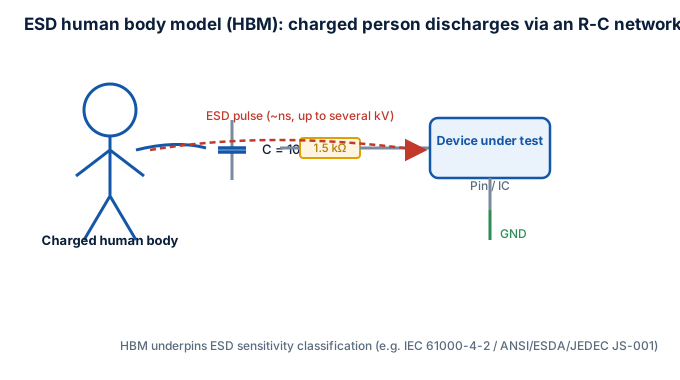
ESD (Electrostatic Discharge) protectors are a specialized form of TVS tuned for high-speed interfaces. The core constraint is not "how much energy" but "clamp ±15 kV human-body discharge in nanoseconds while keeping junction capacitance low enough not to disturb GHz signals."
Common forms: multi-channel TVS arrays, polymer ESD (PESD), multilayer varistors (MLV).
Principle
Still clamping-based: on an ESD event the device limits the pin voltage below the protected IC's rating within nanoseconds, shunting charge to ground. PESD uses a polymer's nonlinearity; MLV uses multilayer ceramic varistor behavior.
Key Parameters
| Parameter | Meaning |
|---|---|
| Vc@8 kV | clamping at IEC 61000-4-2 level 4 (±15 kV contact/air) |
| Cj junction capacitance | lower is better, high-speed needs < 0.5–1 pF |
| response time | ps range |
| channel count | match the interface pins (4-ch, 8-ch arrays) |
| clamp performance | satisfy IEC 61000-4-2 Level 4 |
Selection Checklist
- Pick capacitance by interface speed: USB 3.x, gigabit/10G Ethernet, HDMI 2.x need < 0.5 pF arrays, or signal integrity collapses.
- Place as close to the connector as possible with a short, wide ground trace to cut parasitic inductance.
- Match channel count and polarity: differential lines need symmetric bidirectional arrays.
- Confirm IEC 61000-4-2 Level 4 (±15 kV contact discharge).
Typical Applications
USB / Type-C, HDMI, DisplayPort, Ethernet RJ45, antenna ports, touch-panel ITO layers, SIM/SD sockets.
Coordination with Neighboring Devices
- ESD devices are the "high-speed version" of TVS; understand their parameters within the TVS framework.
- Ports exposed to both external surge and ESD use GDT/MOV (external surge) + ESD array (interface static).
Failure Modes and Life
Solid-state ESD devices are long-lived; after many Level-4 discharges parameters may drift. The key is layout and grounding, not the part itself.
Tip
For high-speed interfaces choose TVS arrays with junction capacitance < 0.5 pF. Slightly higher capacitance can close the eye diagram and raise the bit-error rate.
Next
- Read TVS
- Read Overvoltage selection & coordination