Fuse
One-shot overcurrent protector; the link melts and opens the circuit on short-circuit or severe overcurrent—the last line of overcurrent defense.
Overview
The fuse is the oldest and most reliable overcurrent protector. It stays conductive at normal current; when current exceeds rating—especially the catastrophic overcurrent of a short—the internal element melts from Joule heating and permanently opens the circuit.
Unlike the resettable PPTC, a fuse is one-shot: it sacrifices itself for circuit safety, the true "last line of defense."
Principle
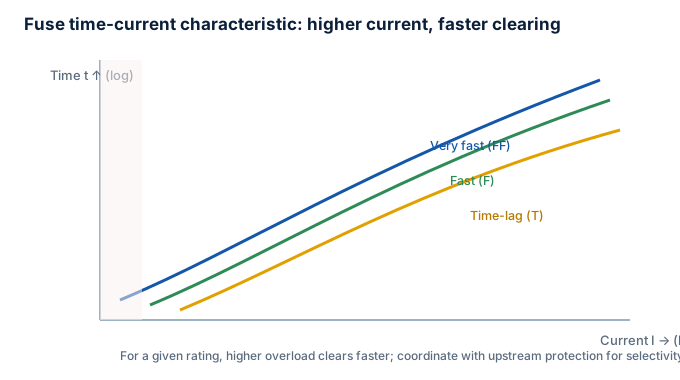
The link accumulates heat per I²t. At normal current, generation and dissipation balance; on overcurrent, generation exceeds dissipation and the link reaches its melting point and blows. The time-current curve is set by element material, cross-section and construction.
Key Parameters
| Parameter | Meaning |
|---|---|
| In rated current | current it can carry long-term |
| Un rated voltage | highest voltage it can safely interrupt |
| I²t joule integral | energy to blow (pre-arc + total) |
| breaking capacity | max short-circuit current it can safely clear (kA) |
| type | fast-acting / time-delay (surge-proof) / HRC (high breaking) |
Selection Checklist
- In by load steady current, with inrush in mind: motor, capacitor and lamp starts need time-delay (slow-blow) types.
- Breaking capacity ≥ expected short-circuit current at the install point; low-voltage distribution needs high-breaking fuses or they may explode.
- Temperature derating: reduce rating in hot environments.
- Coordinate with upstream SPD/PPTC: the fuse sits after them, for short and catastrophic faults.
Typical Applications
Power inputs, transformer primaries, motor windings, battery main loops, instruments.
Coordination with Neighboring Devices
- With PPTC: PPTC resettable for intermittent overcurrent; fuse one-shot for short and catastrophic faults (see PPTC).
- With SPD: an SPD needs a dedicated disconnector or fuse as SCPD to prevent MOV short-circuit fire.
- Not a surge substitute: a fuse barely reacts to nanosecond transients.
Note
The fuse is the "last" protection, after upstream surge/overcurrent devices, specifically to clear short failures and catastrophic overcurrent; it does not replace SPD or TVS transient protection.
Standards
- IEC 60127 (miniature fuses)
- IEC 60269 (low-voltage fuses)
- UL 248
Next
- Read PPTC
- Read Overcurrent selection