Test Method for Inrush-Suppression NTC to UL 1434
Step-by-step breakdown of the seven cyclic / environmental tests, test-equipment setup, pass criteria and a printable record sheet for an inrush-suppression NTC (Vmax=240V / Imax=5A) under UL 1434:2021.
Custom specs
Vmax=240V / Imax=5A / R25=1ohm / Ts=100C, locking in every test condition.
To textSeven tests
Baseline, overload, endurance, low-temp, damp-heat, high-temp aging, temp-cycle.
To textPass criteria
No burn/melt/smoke/short, R25 drift within ±20% (0.8–1.2 ohm).
To textRecord & re-test
3 main + 3 spare + 3 baseline; fully traceable; spares re-run on failure.
To text1. What this article solves
Inrush-suppression NTCs limit the turn-on surge in power supplies, inverters and LED drivers: cold-state high resistance clamps the inrush peak, then self-heats into low-resistance conduction. For North America, the device must pass UL 1434:2021 limit electrical and environmental tests that verify safe, reliable operation at rated conditions.
This article breaks down a customized test plan (Vmax=240V, Imax=5A, R25=1Ω, Ts=100°C): what each test runs at, for how long, where the pass line is, how the equipment is set up and how the record sheet is filled in — ready for lab execution and NRTL submission.
Use the current effective edition
Clause numbers here map to UL 1434:2021. Editions evolve; clause numbers and limits may shift. For certification, check the latest effective edition and defer to qualified personnel. Parameters shown are a custom example (Vmax=240V / Imax=5A); other ratings require re-specifying test conditions.
2. Custom parameters & pass basis (§9.1)
Once the five ratings are fixed, all test conditions and pass criteria follow:
| Parameter | Rated / set value | Role in tests |
|---|---|---|
| Max working voltage Vmax | 240 V | Applied rated voltage throughout |
| Max continuous current Imax | 5 A | Endurance / low-temp current; overload uses 1.2×Imax |
| Zero-power resistance R25 | 1 Ω | Baseline + post-test comparison parameter |
| Max surface temp Ts | 100 °C | Drives high-temp aging (Ts+30) and temp-cycle hot stage |
| Allowed R drift | ≤ ±20% | R25 must stay within 0.8–1.2 Ω after all tests |
In one line: after all 7 tests, the 3 main specimens show no mechanical damage, no electrical failure, R25 drift ≤ ±20% vs. their own baseline, R-T curve matches baseline, and insulation withstand passes — then the batch passes.
3. Pre-test preparation (mandatory)
Specimens: 9 total, same batch & spec, no cosmetic defects, intact leads — 3 baseline, 3 main, 3 spare (spares re-run everything if a main fails / is damaged).
Pre-conditioning: all specimens rest ≥ 4 h at 25°C±2°C, RH 50%±5% until thermally stable, then record each R25, appearance, lead and package state as the baseline.
Equipment (as-procured / as-staged):
| Equipment | Key spec | Purpose |
|---|---|---|
| High-precision R meter | ≤ 0.1% | R25 calibration & re-measure |
| DC regulated supply | 0–300V / ≥10A, current-limited | stable 240V + current limiting |
| Electronic load / current-limit | settable 5A, 6A constant | maps to Imax and 1.2×Imax |
| Temp chamber | -10~150°C, ±2°C | low-temp op, temp cycle |
| Constant T/RH chamber | 0–80°C / 40–98%RH | damp-heat (40°C / 90–95%RH) |
| Temp logger + thermocouple | ±1°C, on NTC surface center | real-time Ts monitoring |
| Cycle timer/controller | auto cycles 50 / 1000 / 6000 | cyclic tests |
| Air-convection aging box | 50–200°C, ±5°C, uniform | high-temp aging (130°C) |
| Hipot tester | 0–500V | post damp-heat insulation check |
4. The seven tests (clause-mapped)
The flow diagram below shows the full path from baseline to final judgement with the pass red-lines:
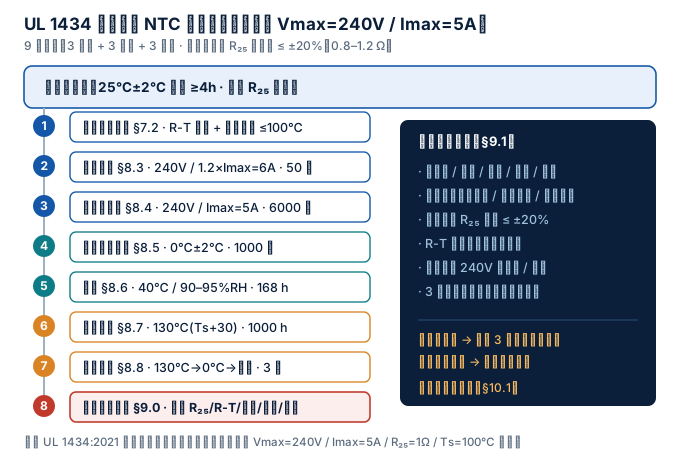
1 · Baseline characterization (§7.2, all 9)
- Measure R25 after 4 h at 25°C±2°C; compare vs. the 1 Ω nominal within spec range;
- Heat the chamber stepwise to 110°C (Ts+10°C), logging R every 3°C to plot the R-T curve and fit B, confirming NTC negative-coefficient behavior with no anomaly;
- Energize at 240V/5A for 30 min; thermocouple measures surface-center temperature, kept ≤ 100°C (Ts).
Pass: R25 in nominal range, R-T curve NTC-characteristic, no cosmetic defects.
2 · Overload cycling (§8.3, 3 main)
- Condition: 25°C±2°C, Vmax=240V, current 1.2×Imax=6A;
- Cycle = energize until surface temp stable (≤100°C) → de-energize and cool back to 25°C±2°C; hold 10 min at the stable state each cycle;
- 50 cycles, pausing every 10 to inspect and re-measure R25.
Pass: no crack/blister/melt/smoke/odor, no open/short, R25 drift ≤ ±20% after 50 cycles.
3 · Endurance cycling (§8.4, 3 main)
- Continue on the same specimens, wiring unchanged; drop current from 6A back to Imax=5A, hold 240V;
- 6000 cycles, re-measure R25 every 1000; on anomaly, switch to spares and redo everything.
Pass: no mechanical damage / electrical failure, R25 drift ≤ ±20% after 6000 cycles.
4 · Low-temperature operation cycle (§8.5, 3 main)
- Condition: ambient 0°C±2°C, 240V/5A, cycle starts cold (rest 2h at 0°C → energize to stable, hold 5 min → cool back to 0°C);
- 1000 cycles, re-measure R25 every 200.
Pass: no mechanical damage / electrical failure, R25 drift ≤ ≤ ±20%.
5 · Damp-heat test (§8.6, 3 main)
- Condition: 40°C±2°C, RH 90–95%, de-energized, held 168 h (7 days);
- Afterward rest 2 h at 25°C/50%RH, then inspect, re-measure R25 and run a 240V hipot.
Pass: no blister/crack on package, no lead corrosion/oxidation, R25 drift ≤ ±20%, hipot clean.
6 · High-temperature aging (§8.7, 3 main)
- Condition: air-convection box at Ts+30°C=130°C (≥70°C meets the requirement), ±5°C, de-energized, held 1000 h; inspect box temp every 200 h;
- Cool to 25°C±2°C, inspect and re-measure R25.
Pass: no crack/deformation/package delamination, R25 drift ≤ ±20%.
7 · Temperature cycle (thermal shock, §8.8, 3 main)
- Condition: 3 full cycles, each = hot 130°C (8h) → cold 0°C±2°C (8h) → room recovery (1h); transfer and room dwell both ≤ 1 min, de-energized;
- After 3 cycles, inspect and re-measure R25.
Pass: as above — no mechanical damage / electrical failure, R25 drift ≤ ±20%.
5. Test circuit & monitoring
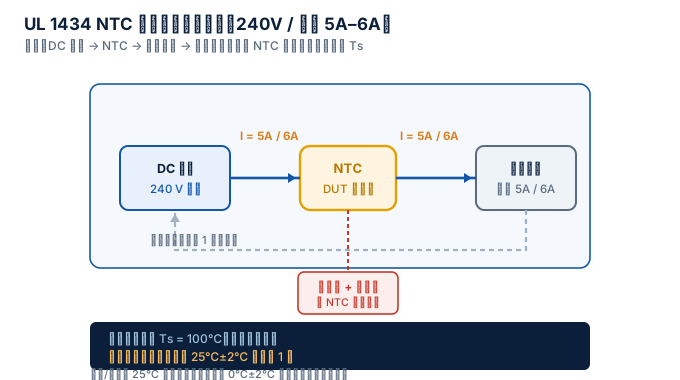
All cyclic tests share one topology: DC supply (240V) through the NTC to the electronic load (current-limited 5A/6A) forming a closed loop; energize to thermal stability, then de-energize and cool to baseline to complete one cycle. A thermocouple on the NTC's surface-center keeps Ts within 100°C.
Execution notes
The 6A overload current must be held constant by the load to avoid distortion; confirm the aging box's ±5°C control so temperature drift doesn't damage specimens or skew data; record all data (current/voltage/temperature/resistance/cycle count/duration/anomalies) for NRTL review (§10.1).
6. Final composite judgement (§9.0)
After all tests, re-measure the 3 main specimens on R25, R-T curve, appearance, electrical continuity, insulation and compare against baseline:
- Safety: no burn, melt, smoke, short or open throughout (§9.1);
- Mechanical: no crack, delamination, loose lead or deformation (§9.1);
- Electrical: R25 drift ≤ ±20%, R-T matches baseline, hipot passes (§9.1);
- Specimens: all 3 mains must pass; any single failure triggers the 3 spares to redo all tests — if spares still fail, the batch fails (§9.3).
7. Printable test record sheet
| Test | Condition | Cycles/Time | S1 R25 | S2 R25 | S3 R25 | Appearance | Pass √/× |
|---|---|---|---|---|---|---|---|
| Baseline | 25°C, 240V/5A | — | |||||
| Overload | 25°C, 240V/6A | 50 | |||||
| Endurance | 25°C, 240V/5A | 6000 | |||||
| Low-temp cycle | 0°C, 240V/5A | 1000 | |||||
| Damp-heat | 40°C / 90–95%RH | 168 h | |||||
| High-temp aging | 130°C, air convection | 1000 h | |||||
| Temp cycle | 130°C(8h)→0°C(8h)→room(1h) | 3 | |||||
| Final composite | review all | — |
How to use
Fill each pause point (overload every 10, endurance every 1000, low-temp every 200) with the then re-measured R25 and appearance to build a complete, traceable record.
8. Common misconceptions
- UL 1434 ≠ IEC 61643: NTC is a current-limiting / inrush device judged by UL 1434's electrical & environmental cycles; you cannot apply IEC 61643 SPD surge-test criteria to it.
- ±20% is not an "average": it's each main specimen's drift vs. its own baseline, and all three must meet it — averaging can't mask a single out-of-spec part.
- 1.2×Imax is overload-only: endurance / low-temp use Imax (5A); using 6A there shortens life and distorts results.
- Aging runs at Ts+30, not room temp: 130°C (≥70°C) stresses long-term thermal behavior; room-temp aging misses the high-temp boundary.
- De-energized tests still degrade parts: damp-heat and high-temp aging run cold, but package sealing and material stability still show up in R25 — out-of-range means fail.
9. Further reading
- Inrush NTC & PTC device library — characteristics, spec sheet and design
- Thermal management domain — temperature-related protection & selection
- Type 3 Cord-Connected SPD — UL 1449 deep-dive — peer standard interpretation