UL 1449 (North-American SPD Safety Standard)
UL 1449 Edition 5 (2022) Type 1–5 classification, MCOV / In / VPR / SCCR key parameters, and why it cannot be equated with IEC or Chinese standards.
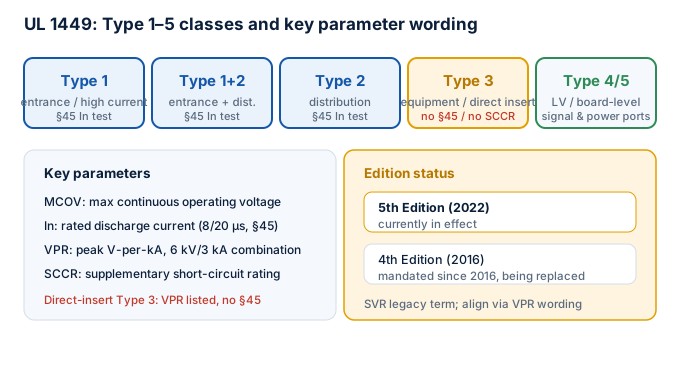
1. Scope and edition
UL 1449 is the North-American (US, Canada) SPD safety certification standard, published by UL (Underwriters Laboratories).
- Edition 5 (2022) is the current active edition (revised again in 2025);
- Edition 4 became mandatory for AC SPDs from 2016;
- Devices covered were historically called TVSS; from Ed. 3/4 they are uniformly called SPDs.
Not interchangeable with IEC / GB
UL 1449's test items, limits and acceptance criteria are self-contained. UL 1449 test results cannot stand in for a GB/T 18802 / IEC 61643 certificate, and vice versa. Export to North America requires a separate UL 1449 evaluation and Listing.
2. Type 1–5 classification
| Type | Installation position | Note |
|---|---|---|
| Type 1 | From the secondary of the service transformer to the line side of the service equipment overcurrent device, and also the load side | Can withstand partial direct-lightning current |
| Type 2 | Load side of the service equipment overcurrent device (distribution, branch) | Most common |
| Type 3 | Point of utilization, at least 10 m (30 ft) from the service panel | Cord, plug-in, receptacle, at-equipment |
| Type 4 | Component assembly (Type 5 elements + disconnect) | Builds a complete SPD |
| Type 5 | Discrete suppression components (e.g. MOV on a PCB) | Component level |
3. Key parameters
- MCOV (Max. continuous operating voltage): the highest voltage the device can endure continuously before clamping begins.
- In (Nominal discharge current): 15 impulses at 8/20 µs (3/5/10/20 kA levels). Done for Type 1/2; Type 3 usually does not run the In sequence — it is evaluated with the combination wave.
- VPR (Voltage protection rating): replaces the older SVR. Maximum limiting voltage measured with a 6 kV / 3 kA combination wave. Note: from Ed. 4 the test current rose from 0.5 kA (Ed. 2) to 3 kA, so VPR is naturally higher than old SVR — the two are not directly comparable.
- SCCR (Short-circuit current rating): after an SPD fails short, it must have an SCCR matching the prospective short-circuit current at its location, or it becomes a fault point in the distribution system. This is a critical, often-overlooked UL requirement, especially for Type 1/2.
4. Type 3 installation constraint
Type 3 must be installed at least 10 m (30 ft) of conductor from the service panel (excluding the SPD's own leads). This lets the upstream SPD dissipate most of the energy, leaving Type 3 to handle only the residual. Mounted right at the panel, a Type 3 can be destroyed outright.
5. Further reading
- IEC 61643 family — classification comparison
- GB/T 18802 and CQC — domestic equivalent
- Updates & Corrigenda
- Type 3 Cord-Connected SPD — UL 1449 Test Deep-Dive