PPTC — Resettable Polyfuse
Polymeric positive-temperature-coefficient resettable protector; overcurrent heats it and resistance jumps to limit current, then it auto-resets on cooling.
Overview
A PPTC (Polymeric Positive Temperature Coefficient device, often called a resettable fuse / PolySwitch) is a resettable overcurrent protector. Normally low-resistance, on overcurrent it heats and its resistance jumps to the kΩ range to limit current; once the fault clears and it cools, it returns to low resistance—no replacement needed.
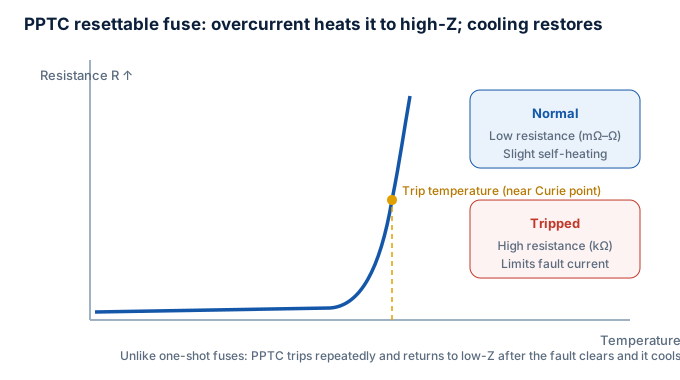
It fills the gap between "one-shot fuse" and "manually-reset thermal relay": repeatable action with zero maintenance.
Principle
A PPTC is a composite of crystalline polymer and conductive particles. At normal current it is low-resistance; overcurrent heats it, the polymer undergoes a crystalline→amorphous phase change that "squeezes off" the conductive path, and resistance rises sharply (PTC effect), limiting current to milliamps. The change is reversible on cooling.
Key Parameters
| Parameter | Meaning |
|---|---|
| Ih hold current | max current that will not trip at 25 ℃ |
| It trip current | current where significant limiting begins (~2×Ih typical) |
| Vmax max voltage | highest safe operating voltage |
| Imax max current | max fault current it can safely interrupt |
| Rmin / Rmax | cold resistance range |
| time to trip | time to reach limiting (depends on overcurrent ratio) |
Selection Checklist
- Ih ≥ normal operating current, with temperature derating: Ih drops as ambient rises, verify at the hottest condition.
- It below the circuit's damage current, so it acts before damage.
- Vmax ≥ max line voltage; Imax ≥ expected fault current.
- Watch cold resistance effect on line drop/power loss (avoid high-R PPTC on high-current loops).
Typical Applications
Li-ion pack secondary protection, port overcurrent, motor stall, speakers/receivers, USB power limiting, communication interfaces.
Coordination with Neighboring Devices
- With TVS/MOV: PPTC handles overcurrent, TVS/MOV handle overvoltage, on the same port.
- With fuse: PPTC is resettable for intermittent faults; fuse is one-shot for catastrophic short (see Fuse).
- Unlike Inrush NTC, PPTC is overcurrent protection, not inrush limiting.
Failure Modes and Life
A PPTC can act many times, but each action adds thermal stress; repeated large-current events accelerate aging and raise cold resistance. Avoid prolonged operation near Ih.
Standards
- UL 1434 (PPTC safety)
- IEC 60738-1 (PTC thermistor generic)
Note
After tripping, a PPTC is not fully open—it holds a small current. For "must hard-disconnect" cases, still pair it with a one-shot fuse.
Next
- Read Fuse
- Read Overcurrent selection