GDT — Gas Discharge Tube
A switch-type protector with inert gas between electrodes; very high surge current and extremely low inter-electrode capacitance, the first-stage device for telecom and signal lines.
Overview
A Gas Discharge Tube (GDT) is a switch-type protector: inert gas sealed in a ceramic tube. Normally the electrodes are insulated (GΩ resistance, < 1 pF capacitance); when voltage exceeds the breakdown threshold the gas ionizes into a plasma channel and instantly conducts, diverting large surge currents.
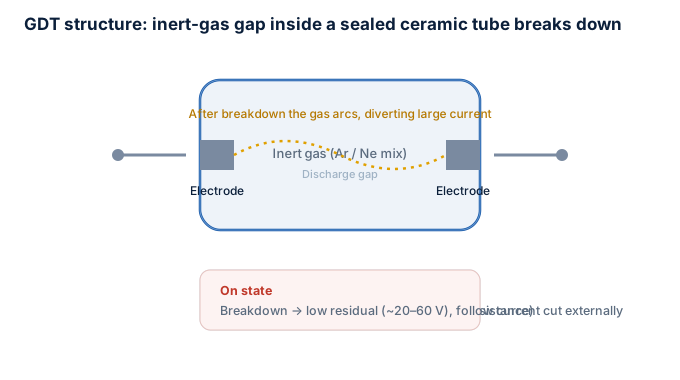
Its two signatures are very high surge current (kA to tens of kA) and extremely low capacitance—making it the natural first-stage choice for telecom, coaxial and signal-line protection.
Principle
A GDT is a "voltage-triggered switch." Before breakdown it barely affects the line; after breakdown it presents a low-impedance path shunting surge current to ground. Response is in the µs range (slower than MOV/TVS) but it handles far more energy and current.
Key Parameters
| Parameter | Meaning |
|---|---|
| Vbr DC breakdown voltage | e.g. 90 V, 230 V, sets the action threshold |
| impulse breakdown voltage | breakdown under fast-rising waves, often higher than DC |
| In nominal current | 8/20 µs repetitive divert current (kA) |
| inter-electrode capacitance | < 1 pF, negligible for high-speed signals |
| response time | µs range |
Selection Checklist
- Vbr must exceed the line's peak operating voltage (incl. transient overshoot), or it will nuisance-fire.
- Use for signal/telecom lines, coax, primary protection—not directly on AC mains.
- Pair with MOV/TVS for second-stage clamping: GDT diverts the current, the downstream device lowers the residual.
- Watch follow-current interruption: on AC mains a GDT may sustain an arc after breakdown.
Typical Applications
Telecom lines (xDSL, ISDN), Ethernet/POE, coaxial cables, antenna feeders, primary protection of power ports.
Coordination with Neighboring Devices
The classic "coarse-mid-fine" cascade:
- GDT (coarse): handles kA-class surges, provides isolation.
- MOV (mid): further clamps the residual after the GDT.
- TVS/ESD (fine): sub-nanosecond fine clamp for precision chips.
Key reminder
Directly on an AC main, a GDT may sustain an arc (follow current) after breakdown and never self-extinguish. Series it with an MOV or restrict it to signal lines to avoid a continuous short.
Failure Modes and Life
After many high-current impulses electrode sputtering shifts the breakdown voltage; it may fail short (affects the line) or open (loses protection). In lightning-heavy regions inspect periodically.
Standards
- ITU-T K.12 (telecom gas discharge tubes)
- IEC 61643-311 (GDTs for SPDs)
- Telcordia GR-974
Next
- Read MOV and TVS
- Read Overvoltage selection & coordination