Overcurrent Selection
How to choose between PPTC (resettable) and Fuse (one-shot), with selection logic by fault type, reset need and breaking capacity, plus coordination notes.
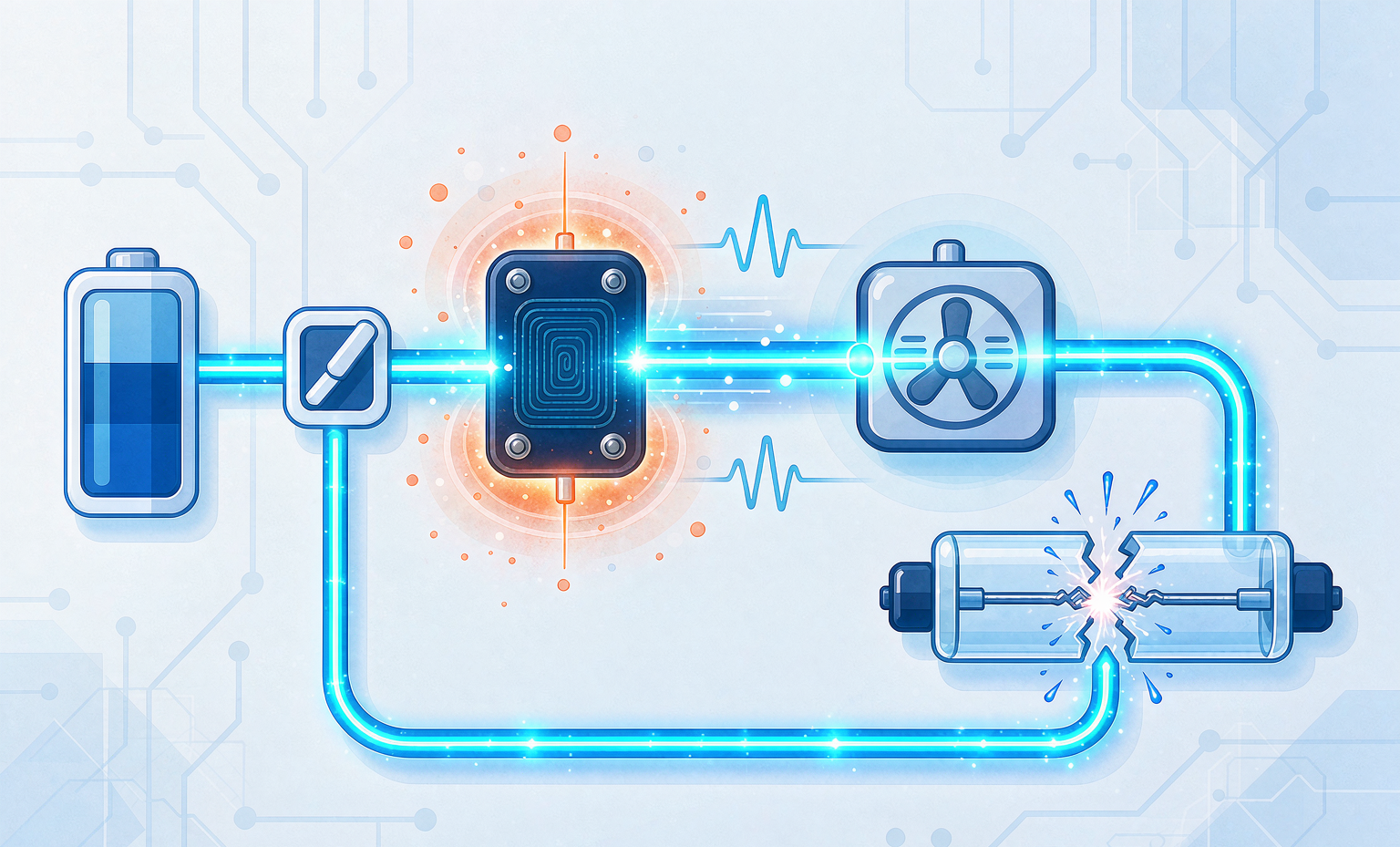
Two OC scenarios
Short circuit (fast clear) vs overload (tolerate & reset).
To textPPTC or Fuse
Resettable → PPTC; one-shot + high breaking → fuse; automotive AEC-Q200.
ViewSelection tree
Derive clearing capacity & time from circuit rated / fault current.
To textOC + OV coordination
PPTC/fuse limits fault current, SPD diverts surge; current-ratio matching.
To textParameter checklist
Ihold/Itrip, breaking capacity, I²t, response time, approvals.
ViewTwo Overcurrent Scenarios
Overcurrent protection must distinguish the fault shape:
- Intermittent overcurrent (stall, plug-in surge, transient load overload): want automatic recovery, no replacement.
- Catastrophic short (insulation breakdown, component short): must cut hard and withstand the expected short-circuit current.
These map to two devices: PPTC and Fuse.
PPTC or Fuse
| Dimension | PPTC resettable | Fuse one-shot |
|---|---|---|
| reset | cools and self-resets | must be replaced |
| best for | intermittent, recoverable | short, catastrophic |
| after trip | holds small current | fully open |
| breaking capacity | limited (see Imax) | high (HRC up to kA) |
| typical place | ports, battery secondary, motor | power input, main loop |
Note
They are not alternatives but coexist: PPTC handles "will-heal" overcurrent; the fuse handles "won't-heal" shorts. A well-designed system has both.
Selection Decision Tree
After overcurrent, how should it be handled?
├─ auto-recover, no replacement → PPTC
│   ├─ Ih ≥ steady current (with temp derating)
│   └─ It < circuit damage current
└─ must hard cut → Fuse
    ├─ big start surge (motor/cap) → time-delay
    ├─ high short risk → HRC high-breaking
    └─ breaking capacity ≥ expected short current
Coordination with Overvoltage Protection
A port often needs both overvoltage and overcurrent protection, with clear roles:
- TVS / MOV / SPD handle "voltage spikes"—clamp overvoltage in nanoseconds.
- PPTC / Fuse handle "too much current"—limit or cut on overcurrent.
- Together: a surge is first clamped by the TVS; if it grows into sustained overcurrent the PPTC trips; if it escalates to a short the fuse cuts.
Key reminder
A fuse cannot substitute for surge protection: it barely reacts to nanosecond transients. Using a fuse to "also block surges" is a common mistake—the result is a fuse that never moves while the chip behind it dies.
Parameter Checklist
- [ ] steady current + temp derating → PPTC Ih / fuse In
- [ ] start surge → need time-delay fuse?
- [ ] damage-current threshold → PPTC It
- [ ] expected short current → fuse breaking capacity
- [ ] reset need → PPTC vs fuse
- [ ] co-layout with TVS/MOV
Next
- Device library: PPTC · Fuse
- Read Overvoltage selection & coordination and Thermal & inrush protection
Two Overcurrent Scenarios
Overcurrent protection must distinguish the fault shape:
- Intermittent overcurrent (stall, plug-in surge, transient load overload): want automatic recovery, no replacement.
- Catastrophic short (insulation breakdown, component short): must cut hard and withstand the expected short-circuit current.
These map to two devices: PPTC and Fuse.
PPTC or Fuse
| Dimension | PPTC resettable | Fuse one-shot |
|---|---|---|
| reset | cools and self-resets | must be replaced |
| best for | intermittent, recoverable | short, catastrophic |
| after trip | holds small current | fully open |
| breaking capacity | limited (see Imax) | high (HRC up to kA) |
| typical place | ports, battery secondary, motor | power input, main loop |
Note
They are not alternatives but coexist: PPTC handles "will-heal" overcurrent; the fuse handles "won't-heal" shorts. A well-designed system has both.
Selection Decision Tree
After overcurrent, how should it be handled?
├─ auto-recover, no replacement → PPTC
│   ├─ Ih ≥ steady current (with temp derating)
│   └─ It < circuit damage current
└─ must hard cut → Fuse
    ├─ big start surge (motor/cap) → time-delay
    ├─ high short risk → HRC high-breaking
    └─ breaking capacity ≥ expected short current
Coordination with Overvoltage Protection
A port often needs both overvoltage and overcurrent protection, with clear roles:
- TVS / MOV / SPD handle "voltage spikes"—clamp overvoltage in nanoseconds.
- PPTC / Fuse handle "too much current"—limit or cut on overcurrent.
- Together: a surge is first clamped by the TVS; if it grows into sustained overcurrent the PPTC trips; if it escalates to a short the fuse cuts.
Key reminder
A fuse cannot substitute for surge protection: it barely reacts to nanosecond transients. Using a fuse to "also block surges" is a common mistake—the result is a fuse that never moves while the chip behind it dies.
Parameter Checklist
- [ ] steady current + temp derating → PPTC Ih / fuse In
- [ ] start surge → need time-delay fuse?
- [ ] damage-current threshold → PPTC It
- [ ] expected short current → fuse breaking capacity
- [ ] reset need → PPTC vs fuse
- [ ] co-layout with TVS/MOV
Next
- Device library: PPTC · Fuse
- Read Overvoltage selection & coordination and Thermal & inrush protection