MOV — Metal Oxide Varistor
Zinc-oxide polycrystalline semiconductor with highly nonlinear V-I characteristics; the most common overvoltage clamping element in SPDs, power supplies and appliances.
Overview
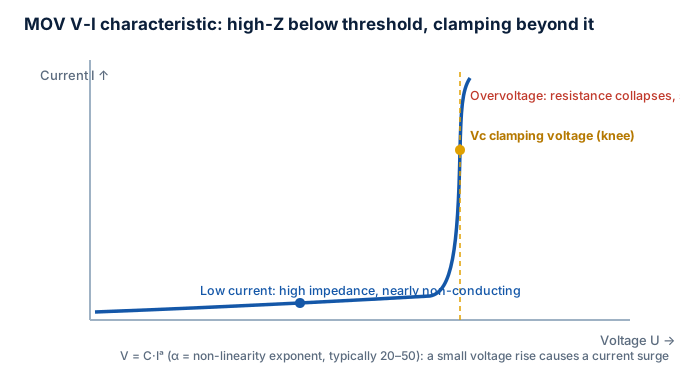
The Metal Oxide Varistor (MOV) is the highest-volume overvoltage clamping component in circuit protection. Its core is a zinc-oxide (ZnO) polycrystalline semiconductor: below its threshold it is high-resistance, and once the voltage exceeds the rated varistor voltage it conducts sharply, absorbing the overvoltage as current.
Alone it is a protection element; it is also the foundation of most SPDs and power-entry protection.
Principle
The V-I characteristic is roughly I = k·V^α, with α typically 20–50, so a small voltage rise yields an exponential current rise—this strong nonlinearity gives "idle until overvoltage, then conduct."
Response time is about 25 ns, between GDT (µs) and TVS (ps).
Key Parameters
| Parameter | Meaning |
|---|---|
| Vn rated varistor voltage | terminal voltage at 1 mA, selection baseline |
| Vc max clamping voltage | residual at a specified peak current (e.g. 100 A/8/20) |
| Ip peak current | 8/20 µs peak withstand (kA) |
| W rated energy | 2 ms rectangular-wave absorbed energy (J) |
| C junction capacitance | hundreds–thousands pF, limits high-speed use |
| response time | ~25 ns |
Selection Checklist
- Choose Vn so the line peak operating voltage < 0.7–0.8 × Vn, avoiding nuisance conduction.
- Vc must be below the protected IC's absolute maximum rating (usually 20% margin).
- Size energy by expected surge: W and Ip must cover the local surge level (e.g. IEC 61000-4-5).
- Account for aging: every impulse causes micro-damage; leakage rises with counts.
Typical Applications
Switched-mode power supplies, relay/contact arc suppression, appliance control boards, telecom distribution frames; combined with GDT/TVS for multi-stage protection.
Coordination with Neighboring Devices
- In series with GDT: GDT handles big current with low residual coordination, MOV does the second fine clamp.
- Complements TVS: MOV for energy, TVS for speed/precision, in a "coarse-mid-fine" cascade (see GDT and TVS).
- Single MOV on AC mains needs thermal protection (see TMOV).
Failure Modes and Life
After repeated impulses Vn drops and leakage rises, eventually shorting → heating → fire. This is the biggest safety hazard of a bare MOV and demands a thermal fuse or TMOV.
Standards
- IEC 61051 (varistor generic)
- GB/T 10193 / 10194
- As an SPD element, IEC 61643-11
Key reminder
A bare MOV ages silently. On mains it can thermally run away and ignite. Use TMOV or add a thermal fuse for any mains-connected MOV.
Next
- Read TMOV
- Read Overvoltage selection & coordination