SPD — Surge Protective Device
Shunt-connected overvoltage protector, classified as Type 1/2/3 by IEC 61643-11, typically built on MOV, GDT or a combination for clamping and diverting surges.
Overview
An SPD (Surge Protective Device) is connected in parallel between the protected line and ground. When a hazardous transient overvoltage appears, its internal nonlinear element turns on within nanoseconds, clamping the overvoltage to a safe level and diverting the surge current away from downstream equipment.
It is the "main breaker" of overvoltage protection—addressing both external intrusions (lightning induction, switching surges) and internal coupling.
Principle and Classification
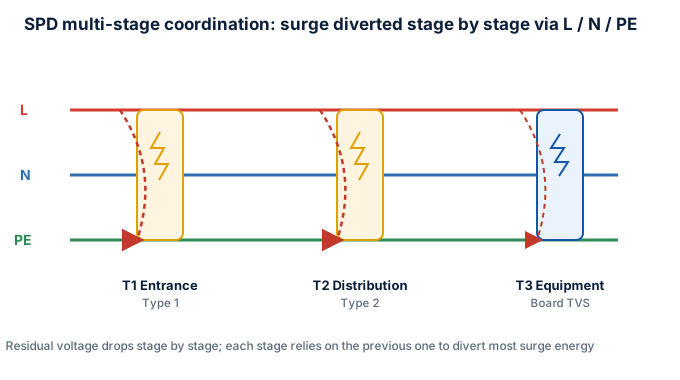
Per IEC 61643-11, SPDs are graded by installation point and expected impulse:
- Type 1: at the service entrance, must withstand 10/350 µs direct-lightning currents (characterized by Iimp).
- Type 2: at distribution boards, for 8/20 µs induced/switching surges (characterized by In).
- Type 3: near equipment, typically In ≤ 5 kA (8/20), used in coordination with upstream devices.
- Type 4: fine in-equipment protection.
Internally, MOVs clamp, or a GDT handles the first big-current stage with an MOV for the second clamp; high-end units include thermal disconnectors and remote-signaling contacts.
Key Parameters
| Parameter | Meaning | Selection |
|---|---|---|
| Uc max continuous operating voltage | long-term applicable voltage | must exceed max line voltage (incl. fault rise in TT) |
| In nominal discharge current | 8/20 µs repetitive | routine protection capability |
| Imax max discharge current | single 8/20 µs extreme | extreme withstand |
| Iimp impulse current | 10/350 µs (Type 1) | direct-lightning withstand |
| Up voltage protection level | clamping residual | must be below equipment withstand Uw |
| Follow-current interrupting | clearing mains follow current | critical in TT/TN |
Selection Checklist
- Pick the Type by location (entrance / distribution / equipment).
- Uc ≥ 1.1× max line voltage; consider tolerance and fault rise.
- Up < equipment rated impulse withstand Uw (also satisfy inter-stage Up margin).
- Coordination: upstream Imax/In greater than downstream, upstream Up ≤ downstream Up (see Overvoltage selection & coordination).
- TT systems: prefer a 3+1 circuit (N-PE branch uses a gas-tube type) to avoid N-line follow current.
Typical Applications
Main distribution, floor distribution, UPS/inverter DC side, PV combiner boxes, network and signal SPDs.
Coordination with Neighboring Devices
- At the equipment end, add TVS / ESD for fine clamping (SPD residual is tens to hundreds of volts; TVS can bring it to a few volts).
- An SPD does not provide overcurrent protection; it must be backed by an SCPD (dedicated disconnector or coordinated fuse) or it may catch fire on MOV short-circuit failure.
- Overcurrent side is handled by PPTC / fuse.
Failure Modes and Life
MOV-based SPDs age with each discharge; leakage rises and the thermal disconnector permanently opens at abnormal temperature, signaling remotely. Periodic leakage and window-indicator checks are required.
Standards
- IEC 61643-11 / GB 18802.1 (low-voltage SPDs)
- IEC 61643-21 (signal-network SPDs)
- UL 1449 (North America)
Key reminder
The upstream overcurrent protective device (SCPD) must be the manufacturer-specified disconnector or a coordinated fuse. A generic circuit breaker may fail to clear an SPD short-circuit in time, causing fire.
Next
- Read Overvoltage selection & coordination
- Read Overcurrent selection
- See MOV and GDT